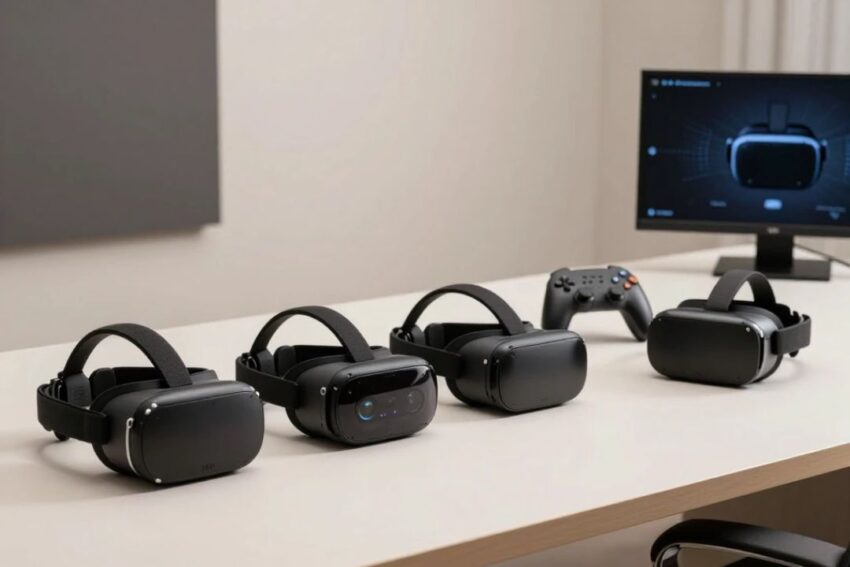
Augmented Reality (AR) and Virtual Reality (VR) wearables have transformed how people experience digital content, blending the physical and virtual worlds in ways that were once purely science fiction. From immersive gaming to professional training simulations, these technologies offer interactive, engaging, and highly customizable experiences. The combination of AR and VR with wearable devices such as headsets, smart glasses, haptic gloves, and motion trackers is reshaping not only entertainment but also education, healthcare, and industrial operations.
Understanding AR and VR Wearables
AR and VR wearables are devices designed to immerse users in a digitally enhanced environment. AR devices overlay digital information onto the physical world, allowing users to see virtual objects, data, or instructions in real time. Popular examples include AR glasses and heads-up displays. VR devices, in contrast, create entirely simulated environments, isolating the user from the physical world and immersing them in a 3D virtual space. VR headsets like the Meta Quest or HTC Vive provide complete visual, auditory, and sometimes tactile immersion.
Both AR and VR wearables rely on sensors, cameras, motion tracking, and high-resolution displays to deliver realistic experiences. They are often combined with haptic feedback devices, such as gloves, vests, or suits, which simulate the sense of touch, enhancing realism and interactivity.
Impact on Gaming
Gaming has been one of the most visible and influential applications of AR and VR wearables. VR gaming immerses players in virtual worlds, offering experiences that are impossible on traditional consoles or PCs. Players can explore detailed environments, interact with virtual objects, and engage in realistic combat, puzzle-solving, or role-playing scenarios. Games like Beat Saber, Half-Life: Alyx, and Resident Evil VR have showcased the potential of VR to transform entertainment into a fully physical and emotional experience.
AR gaming overlays digital elements onto the real world, encouraging players to move through physical spaces to interact with virtual objects. The success of games like Pokémon GO demonstrates the power of AR to combine physical activity, social interaction, and digital engagement. Wearable AR devices provide a more seamless and immersive experience than smartphones, enabling hands-free interaction and enhanced visual fidelity.
Beyond entertainment, AR and VR gaming promote cognitive development, problem-solving skills, and physical activity. VR games often require users to perform coordinated movements, improving hand-eye coordination, spatial awareness, and reaction times. Multiplayer VR environments also foster social interaction, collaboration, and teamwork, even when participants are physically distant.
Professional Training Applications
While gaming has driven the initial adoption of AR and VR wearables, their impact on professional training is even more profound. Industries from healthcare to aviation are leveraging these technologies to provide immersive, risk-free, and cost-effective training.
Healthcare Training
In healthcare, AR and VR wearables allow medical professionals to practice surgical procedures, anatomy exploration, and emergency response scenarios in a safe virtual environment. For example, VR surgical simulators enable surgeons to rehearse complex operations without risk to patients. AR glasses can overlay patient data, anatomical guidance, or step-by-step instructions during procedures, enhancing precision and reducing errors.
These immersive simulations accelerate learning, increase retention, and improve performance under real-world conditions. Medical students and practitioners benefit from repeated practice in realistic scenarios, gaining confidence and skills before performing actual procedures.
Industrial and Technical Training
Industries such as manufacturing, aviation, and energy are using AR and VR wearables to train employees on machinery, equipment operation, and safety protocols. VR simulations recreate hazardous environments, allowing workers to practice emergency responses, machinery troubleshooting, or assembly tasks without risk. AR wearables can provide real-time guidance, highlighting components, displaying instructions, or warning of hazards.
For example, an aircraft maintenance technician wearing AR glasses can receive visual overlays showing parts to inspect, reducing errors and training time. Similarly, VR simulations of construction sites or chemical plants help workers understand complex layouts and safety procedures before entering physical spaces.
Corporate and Soft Skills Training
Beyond technical skills, AR and VR are also used for soft skills and corporate training. VR environments can simulate customer interactions, negotiations, leadership challenges, or cultural scenarios, providing immersive role-playing experiences. Employees can practice communication, decision-making, and conflict resolution in safe, controlled settings, improving performance and confidence.
Enhancing Collaboration and Remote Work
AR and VR wearables are transforming collaboration and remote work. Virtual meeting spaces and shared 3D work environments allow teams to interact as if they were in the same physical location. Participants can manipulate virtual objects, review designs, or brainstorm ideas collectively. This is particularly valuable for fields like architecture, engineering, and product design, where spatial understanding and visualization are critical.
In AR, overlays can guide remote workers, technicians, or field engineers, providing instructions or highlighting problem areas in real time. This reduces the need for on-site supervision, speeds up troubleshooting, and improves productivity.
Challenges and Limitations
Despite their transformative potential, AR and VR wearables face challenges. High costs of advanced devices limit widespread adoption, while technical issues such as latency, motion sickness, and limited battery life can affect user experience. The bulkiness of some headsets and wearables may reduce comfort, particularly during long sessions.
Content creation is another challenge. Developing high-quality VR and AR experiences requires specialized skills, software, and resources. The lack of standardized platforms and interoperability issues can hinder scalability, especially in professional settings.
Privacy and data security are also concerns. AR and VR devices often collect extensive data, including location, biometrics, and behavioral patterns. Ensuring secure storage, transparent usage policies, and user consent is critical to maintaining trust.
Future Prospects
The future of AR and VR wearables is promising. Advancements in lightweight materials, wireless technology, higher-resolution displays, and AI-driven interactions will make these devices more comfortable, immersive, and intelligent. We may see the convergence of AR, VR, and mixed reality (MR), enabling seamless blending of physical and virtual environments.
In gaming, AI-powered VR environments could adapt dynamically to player behavior, creating personalized and highly interactive experiences. In professional training, predictive analytics and real-time performance feedback could optimize learning and skill acquisition. Haptic suits and gloves may become more sophisticated, simulating touch, texture, and resistance for even deeper immersion.
Integration with cloud computing and 5G connectivity will allow complex simulations and massive multiplayer environments without hardware limitations. As AR and VR wearables become more affordable and accessible, their use will expand beyond gaming and training to education, healthcare, social interaction, and daily life.
Conclusion
AR and VR wearables are revolutionizing how we interact with digital content, merging entertainment, education, and professional development in unprecedented ways. In gaming, these technologies provide fully immersive experiences that enhance engagement, cognition, and physical activity. In professional training, they offer safe, efficient, and effective learning opportunities across healthcare, industry, and corporate settings.
While challenges related to cost, comfort, content creation, and data privacy remain, the potential benefits of AR and VR wearables are immense. As technology advances, these devices will continue to reshape human experiences, making learning, collaboration, and entertainment more interactive, engaging, and accessible.
The fusion of AR and VR with wearable technology signals a future where digital and physical worlds are seamlessly intertwined—offering new ways to play, learn, work, and connect. For both casual users and professionals, these wearables represent a powerful tool to enhance capabilities, transform skills, and redefine what is possible in virtual and augmented environments.